Burn XT Official Website › Thermogenic Supplement Guide
Thermogenic Supplement Guide: What The Evidence Supports
Thermogenesis is heat production, and a thermogenic supplement is one that modestly raises the energy your body spends at rest. Four ingredient families have real trial data: caffeine, green tea catechins, capsaicinoids and carnitine. The effects are measurable and small, usually a few percent of a day's energy expenditure, and the outcome reviews for the category are sober.
Written for anyone comparing products in this category, including people who will not buy anything from this desk.
What thermogenesis actually means
Thermogenesis is simply heat production. Your body spends energy keeping itself running, digesting food and moving, and a proportion of that energy leaves as heat. A thermogenic supplement is one that nudges that number upwards.
Three components are worth separating, because the marketing in this category runs them together. Resting energy expenditure is what you spend doing nothing, and it is the largest share by far. The thermic effect of food is what digestion costs, roughly a tenth of what you eat. Activity is everything else, and it is the one with the widest range between two people.
A thermogenic ingredient generally works on the first of those, by a few percent, for a few hours. That is worth knowing before any comparison, because it sets the ceiling on what any product in this category can plausibly do, no matter what is on the front of the bottle.
It is also why the honest way to measure one is in a whole-room calorimeter over 24 hours rather than by taking a metabolic reading an hour after a dose. The second method makes almost anything look impressive.
Four ingredient families with real trial data
| Family | What it does | Typical trial amount | Evidence |
|---|---|---|---|
| Caffeine | Raises alertness and resting energy expenditure for a few hours; modest appetite effect | 100 to 400 mg acute | Strong. The most reliably demonstrated ingredient in the category |
| Green tea catechins | Extends the caffeine effect across a day; measured as EGCG content | 90 to 300 mg EGCG daily | Good for mechanism, weak for outcome. See the Cochrane review below |
| Capsaicinoids | Raise energy expenditure in the hours after a dose | 2 to 12 mg capsaicinoids | Moderate. Consistent direction, small effect sizes |
| Carnitine | Transports fatty acids into the mitochondrion; works over weeks | 1,500 to 3,000 mg daily | Moderate and shrinking. Effects diminish in longer trials |
Everything else this category sells, and there is a great deal of it, has less than this behind it.
The single most useful study to know. A 1999 crossover trial found a green tea extract supplying 90 mg of EGCG with 50 mg of caffeine raised 24-hour energy expenditure by about 4 percent, while the same caffeine alone did not (Dulloo and colleagues, 1999). Almost every product in this category is built on that result, and almost none of them tells you it is 4 percent.
What the outcome reviews find
A mechanism study and an outcome review answer different questions, and a website that quotes only the first is choosing which question you get to hear.
The Cochrane review of green tea preparations for weight loss and weight maintenance in overweight or obese adults found the effect on body weight small and not clinically important (Jurgens and colleagues, 2012). A meta-analysis of catechin-rich teas found the energy expenditure effect real but blunted in habitual caffeine consumers (Hursel and colleagues, 2011), which is most of the people buying these products.
For carnitine, a meta-analysis of 37 randomised trials found small average reductions in weight and body mass index, with the effect shrinking as trials got longer (Talenezhad and colleagues, 2020), and an earlier meta-analysis reached the same shape of conclusion (Pooyandjoo and colleagues, 2016).
For the category as a whole, the National Institutes of Health review of dietary supplements for weight loss is the document to read, and it is not encouraging (NIH Office of Dietary Supplements). The Federal Trade Commission publishes consumer guidance on the advertising in this category for related reasons (the truth behind weight-loss ads).
None of that makes these ingredients useless. It makes the honest claim a modest one: they can make a deficit slightly easier to hold, and they cannot create one.
The question nobody asks about the stimulant
Most thermogenic products are, functionally, caffeine with supporting ingredients. That is not a criticism; caffeine is the ingredient in this category with the best evidence behind it. But it changes the questions worth asking.
How much, and is it printed? A label that hides its caffeine inside a proprietary blend is hiding the most important number on it. A label that prints 270 milligrams a serving is telling you something about how it expects to be judged.
How does it sit against your day? The Food and Drug Administration puts 400 milligrams a day as the amount not generally associated with negative effects in healthy adults (FDA consumer guidance). A serving that is two thirds of that leaves room for one coffee, not four.
When do you take it? A randomised study found 400 milligrams of caffeine taken six hours before bed still measurably reduced sleep, and participants largely did not notice (Drake and colleagues, 2013). A thermogenic that costs you an hour of sleep a night is working against the thing you bought it for.
Are you already saturated? The catechin meta-analysis found the effect blunted in habitual caffeine consumers. If you drink three coffees a day, part of what this category sells is something you already have.
What to avoid in this category
- ›A proprietary blend. A single weight covering several names means no individual amount can be checked, and the stimulant is usually the reason.
- ›An extract weight with no standardisation. Four hundred milligrams of green tea extract could be almost anything without an EGCG percentage beside it.
- ›Yohimbine, synephrine or anything DMAA-adjacent. Higher risk, thinner evidence, and a recurring source of regulatory action.
- ›A promised number. Nothing in this category has evidence supporting a quantified outcome promise, and making one is a regulatory problem as well as a credibility one.
- ›Before-and-after photographs. Nothing here has been trialled in a way that could support one.
- ›A guarantee shorter than the product takes. A thirty-day window on a product that works over six weeks is a window you cannot use.
- ›No telephone number and no returns address. The two things a refund conversation actually depends on.
Four questions worth asking
What is the stimulant load, in milligrams?
If the label will not tell you, that is the answer to the question. If it will, compare it to what you already drink before you compare it to anything else.
What does a serving actually deliver?
Not per bottle and not per capsule. Per serving, at the serving the label directs, which on a two-column panel is not always the one the marketing quotes.
How does each amount compare to the trials?
A good product will be inside the range on some ingredients and below it on others. A product that claims to be at trial amounts on everything is either expensive or lying.
How long is the window, and who pays the postage?
The window is part of the price. So is return postage, which is at the buyer's expense almost everywhere in this category.
This guide applied to one label
Applying the four questions above to the product this website sells produces a mixed answer, which is what an honest application usually produces.
The stimulant load is printed: 270 milligrams a serving, 135 a capsule. The serving is defined and the panel shows both columns. Two of the five amounts sit below the trial ranges, the green tea extract sits inside its range at the lower-middle, the caffeine sits squarely inside, and one ingredient cannot be judged at all because the Capsimax row prints an extract weight with no capsaicinoid fraction. The window is sixty days, which is longer than the three to six week wait buyers report, and return postage is at the buyer's expense.
That is four passes, two partial and one that cannot be assessed. The full nine-point version, with the scoring written out, is in choosing a thermogenic supplement, and the underlying numbers are on the ingredients page.
Who wrote this guide
This desk publishes what the printed panel says and marks the gaps. The four claims below are the ones a sceptical reader can audit, which is the only reason to make them:
- The panel is the source. Figures come from the Supplement Facts panel photographed on the bottle, not from the manufacturer's marketing artwork. Where the two disagree, the panel is published and the disagreement is named on the page.
- Not published stays not published. Nothing undisclosed is estimated here. Pack prices are set at checkout, so no price is printed anywhere on this website.
- Sources are real and linked in the sentence. Every study cited was confirmed against its PubMed record first, and each appears beside the amount it used.
- Corrections change the date. Write to [email protected] and the review date moves forward.
We earn when you buy. Burnxts is the authorized United States retail desk for this product and this website makes money on orders placed through it. That is exactly why the caffeine figure is in the hero, why the research-dose table is on the ingredients page, and why the three-star reviews are published at the same size as the five-star ones. They are where our interest and yours pull apart, and you should be able to watch us choose.
On this page specifically: no product name appears in any subheading, and the outcome reviews are quoted before the mechanism studies rather than after them, because that is the order in which they should change your mind.

Every page, every journal post, the bottle facts and the ingredients go through review by Dr. Pascale Carbonara, MD before they ship. We write these pages from the printed Burn XT Supplement Facts panel and this desk’s own paperwork, cite public research for acetyl L-carnitine, green tea catechins, caffeine, capsaicinoids and piperine beside the amounts that research actually used, and print “not published” wherever a figure is not disclosed rather than estimating it. Where the manufacturer’s artwork claims more than the panel supports, we say so on the page. This desk has no named clinical reviewer and does not pretend to. Corrections are made on the page itself and the review date moves forward. Write to [email protected]. Last reviewed September 2026.
Sources for this guide
- Dulloo 1999. Dulloo AG, Duret C, Rohrer D, et al. Efficacy of a green tea extract rich in catechin polyphenols and caffeine in increasing 24-h energy expenditure and fat oxidation in humans. American Journal of Clinical Nutrition. 1999;70(6):1040-1045. PMID 10584049. https://pubmed.ncbi.nlm.nih.gov/10584049/
- Hursel 2011. Hursel R, Viechtbauer W, Dulloo AG, et al. The effects of catechin rich teas and caffeine on energy expenditure and fat oxidation: a meta-analysis. Obesity Reviews. 2011;12(7):e573-e581. PMID 21366839. https://pubmed.ncbi.nlm.nih.gov/21366839/
- Jurgens 2012 (Cochrane). Jurgens TM, Whelan AM, Killian L, Doucette S, Kirk S, Foy E. Green tea for weight loss and weight maintenance in overweight or obese adults. Cochrane Database of Systematic Reviews. 2012;(12):CD008650. PMID 23235664. https://pubmed.ncbi.nlm.nih.gov/23235664/
- Berube-Parent 2005. Berube-Parent S, Pelletier C, Dore J, Tremblay A. Effects of encapsulated green tea and Guarana extracts containing a mixture of epigallocatechin-3-gallate and caffeine on 24 h energy expenditure and fat oxidation in men. British Journal of Nutrition. 2005;94(3):432-436. PMID 16176615. https://pubmed.ncbi.nlm.nih.gov/16176615/
- Talenezhad 2020. Talenezhad N, Mohammadi M, Ramezani-Jolfaie N, et al. Effects of l-carnitine supplementation on weight loss and body composition: a systematic review and meta-analysis of 37 randomized controlled clinical trials with dose-response analysis. Clinical Nutrition ESPEN. 2020;37:9-23. PMID 32359762. https://pubmed.ncbi.nlm.nih.gov/32359762/
- Pooyandjoo 2016. Pooyandjoo M, Nouhi M, Shab-Bidar S, Djafarian K, Olyaeemanesh A. The effect of (L-)carnitine on weight loss in adults: a systematic review and meta-analysis of randomized controlled trials. Obesity Reviews. 2016;17(10):970-976. PMID 27335245. https://pubmed.ncbi.nlm.nih.gov/27335245/
- Irandoost 2021. Irandoost P, Lotfi Yagin N, Namazi N, et al. The effect of capsaicinoids or capsinoids in red pepper on thermogenesis in healthy adults: a systematic review and meta-analysis. Phytotherapy Research. 2021;35(3):1358-1377. PMID 33063385. https://pubmed.ncbi.nlm.nih.gov/33063385/
- Zsiboras 2018. Zsiboras C, Matics R, Hegyi P, et al. Capsaicin and capsiate could be appropriate agents for treatment of obesity: a meta-analysis of human studies. Critical Reviews in Food Science and Nutrition. 2018;58(9):1419-1427. PMID 28001433. https://pubmed.ncbi.nlm.nih.gov/28001433/
- FDA on caffeine. U.S. Food and Drug Administration. Spilling the beans: how much caffeine is too much? https://www.fda.gov/consumers/consumer-updates/spilling-beans-how-much-caffeine-too-much
- Drake 2013. Drake C, Roehrs T, Shambroom J, Roth T. Caffeine effects on sleep taken 0, 3, or 6 hours before going to bed. Journal of Clinical Sleep Medicine. 2013;9(11):1195-1200. PMID 24235903. https://pubmed.ncbi.nlm.nih.gov/24235903/
- NIH ODS weight-loss supplements. National Institutes of Health, Office of Dietary Supplements. Dietary supplements for weight loss: fact sheet for health professionals. https://ods.od.nih.gov/factsheets/WeightLoss-HealthProfessional/
- FTC on weight-loss advertising. U.S. Federal Trade Commission, consumer advice. The truth behind weight loss ads. https://consumer.ftc.gov/articles/truth-behind-weight-loss-ads
- NCCIH green tea. National Center for Complementary and Integrative Health. Green tea: usefulness and safety. https://www.nccih.nih.gov/health/green-tea
- Harvard Nutrition Source. Harvard T.H. Chan School of Public Health, The Nutrition Source. Caffeine. https://nutritionsource.hsph.harvard.edu/caffeine/
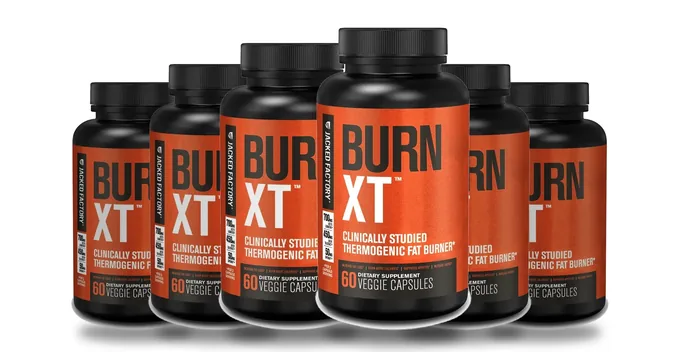
A thermogenic label you can actually check
Five actives, every amount printed twice, and a sixty-day window. The guide above is the standard; the product pages show the working.
Price shown at checkout · 60-day money-back window
Order Burn XT On The Official WebsiteOne-time payment, no subscription · 60-day money-back window · lot BUR-26/BU-6491 · order desk +1 (520) 206-1597