Per Capsule Or Per Serving? Reading A Two-Column Panel
- A Supplement Facts panel with two columns is being honest. Marketing that quotes only the larger one is not.
- Burn XT prints both: 350 mg and 700 mg of acetyl L-carnitine, 135 mg and 270 mg of caffeine, and so on.
- Take one capsule and you are getting half of every figure you have read in the advertising.
- Servings per container is the second number people misread, and it decides how long a bottle lasts.
- Five checks, in order, tell you almost everything a label can tell you. They are at the end of this article.
A note before you read on. Burn XT is a dietary supplement, not a treatment for anything. Nothing on this page is medical advice and none of it can know what else you take. Each two-capsule serving carries 270 mg of caffeine and 5 mg of piperine, and those two numbers are the ones to carry into a conversation with a pharmacist or a doctor before you start.
There is a particular kind of misunderstanding that happens with supplement labels, and it is not caused by dishonesty on the panel. The panel is a regulated document and it usually tells the truth carefully. The misunderstanding happens in the gap between the panel and everything printed around it.
The commonest version of that gap is a two-column serving panel.
It is not a trick, it is a column heading
Some products have one sensible serving. Others have a range, because tolerance varies or because the manufacturer expects people to build up. A panel for the second kind of product often prints two columns: one for the smaller serving and one for the larger.
That is a service to the reader. It lets somebody taking a single capsule work out what they are actually getting, without arithmetic and without guessing.
The problem arrives when a listing, an advertisement or a review quotes the larger column and does not say so. The figures are accurate and the impression is wrong, and the reader has no way to tell from the sentence in front of them.
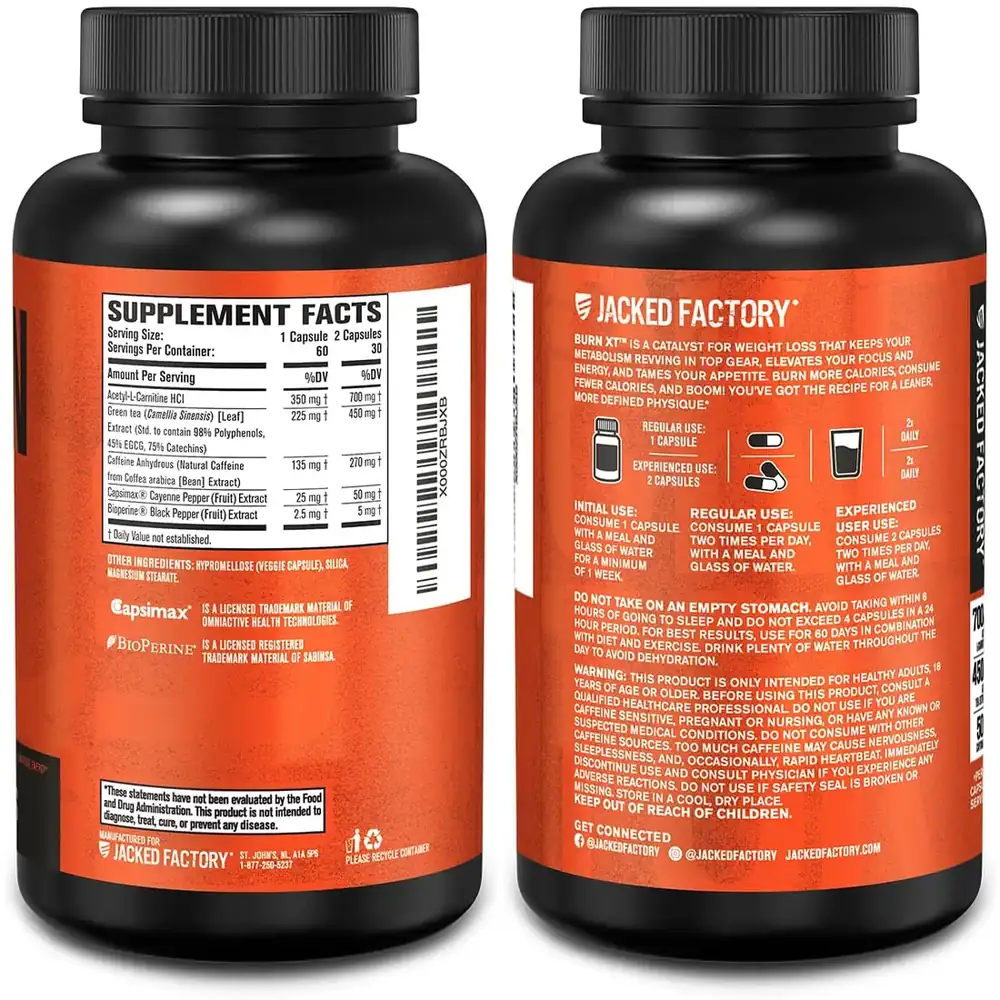
How this panel is laid out
Here is the Burn XT panel with both columns, which is how a panel should be read and almost never how it is quoted.
| Ingredient | 1 capsule | 2 capsules | % Daily Value |
|---|---|---|---|
| Acetyl-L-Carnitine HCl | 350 mg | 700 mg | Not established |
| Green tea leaf extract | 225 mg | 450 mg | Not established |
| Caffeine anhydrous | 135 mg | 270 mg | Not established |
| Capsimax cayenne pepper fruit extract | 25 mg | 50 mg | Not established |
| BioPerine black pepper fruit extract | 2.5 mg | 5 mg | Not established |
Other ingredients: Hypromellose (vegetable capsule), silica, magnesium stearate.
Three observations that most readers miss on a first pass:
- The caffeine row is the one that matters most for safety. 135 milligrams is an ordinary mug of coffee. 270 is two to three mugs at once. Which of those you are taking is a real decision and the panel lets you make it.
- The Daily Value column says not established, five times. That is not a criticism of the product. It means no reference intake has been set for these ingredients, so no percentage can be printed for any of them.
- The standardisation line sits inside the green tea row, not beneath the panel, and it is the most informative thing on the label.
Why marketing quotes the larger column
For the obvious reason, and for a less obvious one.
The obvious one is that larger numbers sell. Seven hundred milligrams reads better than three hundred and fifty, and four hundred and fifty reads better than two hundred and twenty-five.
The less obvious one is comparability. The research a manufacturer wants to point at generally used the larger amounts, so quoting the larger column is what makes the comparison possible at all. That is a legitimate motivation and it still leaves the reader with an impression that does not match a single capsule.
This is worth holding alongside the fact that the dose in the advertisement is often still below the research amount. On this label, acetyl L-carnitine at 700 milligrams is the larger column and is still a quarter to a half of what most trials used (Talenezhad and colleagues, 2020). The full comparison is on the ingredients page.
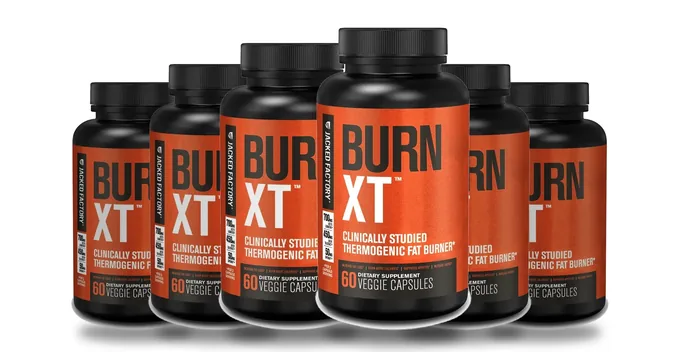
A panel that prints both columns
Five actives, two serving columns, a standardisation figure and no proprietary blend. Sixty days to change your mind.
Price shown at checkout
Order Burn XTThree more places the same thing happens
The two-column trick has relatives, and they all work the same way: an accurate number in a misleading frame.
Extract weight instead of active content
Four hundred and fifty milligrams of green tea extract could be almost anything without a standardisation percentage. The number that matters is the EGCG content, and a label that prints only the extract weight has told you the weight of a box rather than what is in it.
A branded ingredient with no active fraction
This panel prints 50 milligrams of Capsimax and no capsaicinoid figure. The capsaicinoid content is what the research uses (Irandoost and colleagues, 2021), so the comparison cannot be made. It is the one real omission on an otherwise transparent label and this website says so on four separate pages.
A proprietary blend
The worst of the three, and the one this label does not do. A single weight covering several names means no individual amount can be checked, and the ingredient being protected is very often the stimulant.
Servings per container, and the arithmetic it hides
The second number people misread sits directly under the serving size, and it decides how long a bottle lasts.
| If you take | Servings in a bottle | Days a bottle lasts | A 3-bottle order |
|---|---|---|---|
| One capsule a day | 60 | 60 days | Six months |
| One capsule twice a day | 30 | 30 days | Three months |
| Two capsules once a day | 30 | 30 days | Three months |
| Two capsules twice a day | 15 | 15 days | Six weeks |
All four of those appear somewhere in this product's printed directions. Which one you follow changes the cost per day fourfold.
This is why comparing two products by bottle price tells you almost nothing. A ninety-capsule bottle at three capsules a serving is thirty servings, exactly like a sixty-capsule bottle at two. Comparing per serving is the only comparison that means anything, and it is the one the packaging makes hardest.
Five steps for reading any panel
In this order. It takes about ninety seconds once you have done it twice.
- Find the serving size, and the number of columns. Before you read a single ingredient. Everything else on the panel is relative to this.
- Find the servings per container. Multiply by the serving size and check it equals what is in the bottle. If it does not, you have misread the serving.
- Look for a blend line. One weight covering several names means those amounts are not disclosed. Stop and decide whether you mind.
- Look for a standardisation on every extract. A percentage, or a named marker compound with an amount. Without it, an extract weight is not comparable to any trial.
- Read the other-ingredients line. It is where the capsule shell, the flow agents and any allergen live, and it is the line that tells a vegetarian whether they can take it.
The longer version of this, as a nine-point checklist applied to a real label, is in choosing a thermogenic supplement. The regulator's own consumer starting point is also worth one read (FDA questions and answers on dietary supplements).
What a standardisation line adds
Of the five steps above, the fourth is the one that separates a label you can evaluate from one you cannot, and it is worth its own section.
| What the label prints | What you can conclude |
|---|---|
| 450 mg green tea extract | Almost nothing. The catechin content could vary several-fold |
| 450 mg green tea extract, standardised to 45% EGCG | About 200 mg EGCG a serving, which is directly comparable to the trials |
| 450 mg green tea extract, 98% polyphenols, 45% EGCG, 75% catechins | All of the above, plus confidence that the extraction is a concentrated one |
This label prints the third version. Most of its competitors print the first.
Why that matters concretely: the crossover study most often cited for this combination used a green tea extract supplying 90 milligrams of EGCG with 50 milligrams of caffeine (Dulloo and colleagues, 1999). Without an EGCG figure on the label in front of you, there is no way to place a product against that number at all.
What no panel can tell you
Finally, the limits. A Supplement Facts panel is a composition statement, and there are four questions it structurally cannot answer.
- Whether the contents match the declaration. That is a laboratory question. A third-party verification mark from a body that tests finished bottles is the strongest available answer, and most products in this category do not carry one.
- Where anything was made or grown. The panel says what is in it, not where it came from.
- Whether the product was tested as a finished formula. Almost nothing in this category has been, and a phrase like clinically studied on a front label usually refers to the ingredients rather than the capsule.
- Whether it is right for you. No panel knows what else you take. That is what the pharmacist is for (NCCIH, using supplements wisely).
None of which makes the panel unimportant. It is the most reliable thing on the bottle by a distance. It just has a job description, and knowing where that job ends is the last piece of label literacy worth having.
Every figure on this website comes from that panel, transcribed on the supplement facts page, and where a figure is not on it, the page says so instead of estimating.
Sources
- FDA supplement Q&A. U.S. Food and Drug Administration. Questions and answers on dietary supplements. https://www.fda.gov/food/information-consumers-using-dietary-supplements/questions-and-answers-dietary-supplements
- Dulloo 1999. Dulloo AG, Duret C, Rohrer D, et al. Efficacy of a green tea extract rich in catechin polyphenols and caffeine in increasing 24-h energy expenditure and fat oxidation in humans. American Journal of Clinical Nutrition. 1999;70(6):1040-1045. PMID 10584049. https://pubmed.ncbi.nlm.nih.gov/10584049/
- Talenezhad 2020. Talenezhad N, Mohammadi M, Ramezani-Jolfaie N, et al. Effects of l-carnitine supplementation on weight loss and body composition: a systematic review and meta-analysis of 37 randomized controlled clinical trials with dose-response analysis. Clinical Nutrition ESPEN. 2020;37:9-23. PMID 32359762. https://pubmed.ncbi.nlm.nih.gov/32359762/
- Irandoost 2021. Irandoost P, Lotfi Yagin N, Namazi N, et al. The effect of capsaicinoids or capsinoids in red pepper on thermogenesis in healthy adults: a systematic review and meta-analysis. Phytotherapy Research. 2021;35(3):1358-1377. PMID 33063385. https://pubmed.ncbi.nlm.nih.gov/33063385/
- NCCIH on using supplements. National Center for Complementary and Integrative Health. Using dietary supplements wisely. https://www.nccih.nih.gov/health/using-dietary-supplements-wisely
- NIH ODS consumer guide. National Institutes of Health, Office of Dietary Supplements. Dietary supplements: what you need to know. https://ods.od.nih.gov/factsheets/WYNTK-Consumer/

Every page, every journal post, the bottle facts and the ingredients go through review by Dr. Pascale Carbonara, MD before they ship. We write from the printed Burn XT Supplement Facts panel and this desk’s own paperwork, confirm every PubMed identifier against the eutils summary API before publishing it, and print “not published” wherever a figure is not disclosed. This desk sells the product it writes about and says so on every page that touches money. Corrections go to [email protected] and move the review date forward. Last updated 17 September 2026.