Green Tea Extract And Your Liver: What To Know First
- Concentrated green tea extract carries a rare but documented association with liver injury. Drinking green tea does not.
- A United States Pharmacopeia expert panel reviewed the evidence in full and recommended a caution statement on products of this kind.
- The cases cluster in high doses taken on an empty stomach, which is exactly what this product's back label tells you not to do.
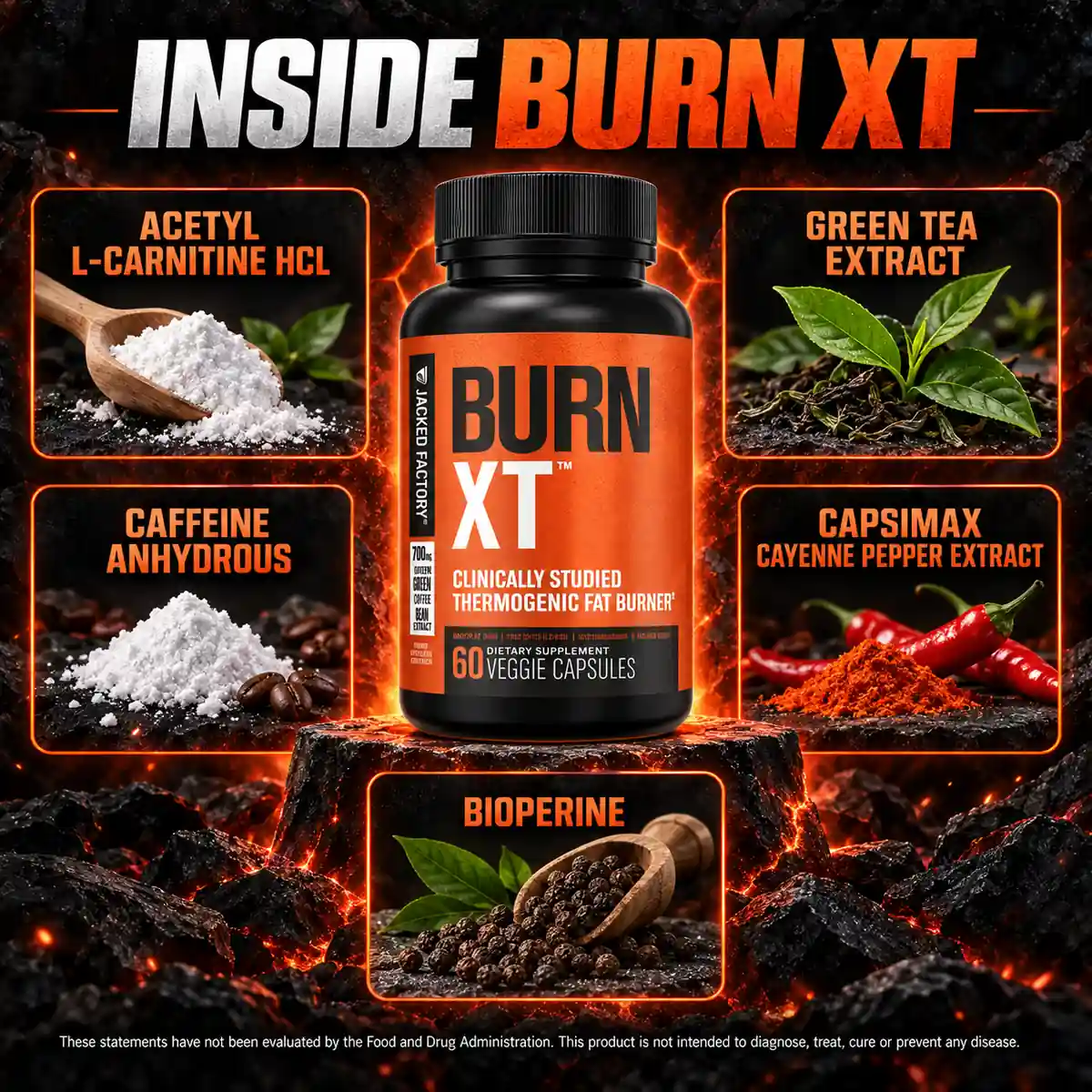
- A Burn XT serving supplies 450 mg of extract, roughly 200 mg of EGCG, standardised on the label.
- The warning signs are dark urine, pale stools, abdominal pain, unusual tiredness and any yellowing of skin or eyes. Any of them means stop and see a doctor.
A note before you read on. Burn XT is a dietary supplement, not a treatment for anything. Nothing on this page is medical advice and none of it can know what else you take. Each two-capsule serving carries 270 mg of caffeine and 5 mg of piperine, and those two numbers are the ones to carry into a conversation with a pharmacist or a doctor before you start.
This is the section most websites selling a green tea extract leave out, which is a reasonable indication that it is worth reading. The evidence is not dramatic and it is not nothing, and the practical conclusion is a single instruction that is already printed on the bottle.
Green tea, the drink, has an excellent safety record measured in centuries. Concentrated green tea extract, sold in a capsule at many times the catechin content of a cup, is a different proposition, and the difference is the whole of this article.
What is actually in 450 mg of extract
The Burn XT panel prints something most labels do not: a standardisation line. The green tea leaf extract is standardised to 98 percent polyphenols, 45 percent EGCG and 75 percent catechins. That lets you do arithmetic a blank extract weight would make impossible.
| From the panel | Arithmetic | Per serving |
|---|---|---|
| 450 mg extract, 45% EGCG | 450 × 0.45 | About 200 mg EGCG |
| 450 mg extract, 75% catechins | 450 × 0.75 | About 340 mg catechins |
| 450 mg extract, 98% polyphenols | 450 × 0.98 | About 440 mg polyphenols |
| 225 mg extract, one capsule | 225 × 0.45 | About 100 mg EGCG |
For scale, a brewed cup of green tea supplies somewhere in the region of 50 to 100 milligrams of EGCG depending on leaf, quantity and steeping time. So a full serving of this product is in the region of two to four cups of tea worth of EGCG, delivered in one swallow and without the water.
That is not an alarming multiple. It is also not trivial, and it is the multiple that matters for everything below.
The liver signal, and how big it is
Case reports of liver injury associated with green tea extract have accumulated over roughly two decades. They are rare against the very large number of people taking these products, and they are consistent enough in pattern to be taken seriously rather than dismissed.
Three features recur across the reports:
- Concentrated extract, not the drink. The association is with supplemental extracts. Tea drinking does not carry it.
- Higher doses. The cases cluster at the upper end of what supplements supply, frequently well above what a single-ingredient thermogenic provides.
- Taken on an empty stomach. This one appears again and again, and it is the feature a buyer can actually act on.
There is also an individual susceptibility element that nobody can currently predict. Some of the reports involve people with a genetic variation affecting how catechins are processed. There is no test you can take before buying a bottle, which argues for knowing the warning signs rather than for assuming they will not apply to you.
What the USP panel concluded
The United States Pharmacopeia convened an expert panel to review the hepatotoxicity evidence for green tea extracts and published a comprehensive review of it (Oketch-Rabah and colleagues, 2020). The full text is free to read (PubMed Central) and it is a better source than any summary, including this one.
The panel's conclusions, in plain words:
- The risk of liver injury from green tea extract is low but real.
- The evidence supports a caution statement on products containing concentrated green tea extract.
- Taking it with food is associated with a lower risk than taking it fasted.
- Consumers should be told the warning signs of liver problems so they can stop and seek advice early.
The National Center for Complementary and Integrative Health reaches the same position in its own summary of green tea (NCCIH on green tea), and it is the plainer of the two if you want a short version.
That is the complete honest picture: a low but real risk, a clear mitigation, and a set of symptoms worth memorising. Everything else on this page follows from those three.
A green tea extract with its numbers printed
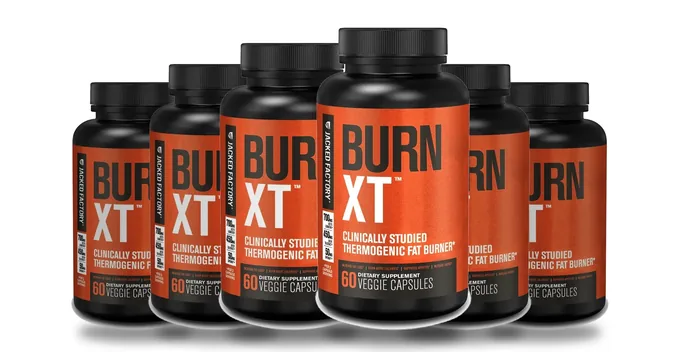
450 mg standardised to 45 percent EGCG, taken with food, on a label that prints the percentage rather than an extract weight alone.
Price shown at checkout
Order Burn XTWhy with food is the whole instruction
The Burn XT back label carries the line do not take on an empty stomach, in capital letters, before it says anything else. Most buyers read it as a warning about nausea. It is that, and it is also the single practical thing the USP review recommends.
Both printed direction sets say the same thing in different words. The sales listing says to take two capsules once daily with food. The bottle's own build-up instructions say one capsule with a meal and a glass of water for the first week, then one capsule twice a day, each with a meal and a glass of water. There is no version of the directions that involves a capsule and nothing else.
Practically, that means a real meal rather than a coffee and rather than a piece of fruit on the way out. The instruction is easy, it costs nothing, and it addresses the one variable in this entire article that you control.
The same instruction incidentally solves two other problems: the capsaicinoid warmth from the Capsimax and the stomach discomfort caffeine causes in some people on an empty stomach. One instruction, three reasons.
The warning signs worth knowing
Liver problems announce themselves in ways that are easy to attribute to something else, which is why a list is more useful than a reassurance.
| Sign | What it looks like | What to do |
|---|---|---|
| Unusual tiredness | Fatigue out of proportion to your week | Note it. If it persists with anything else here, stop and see a doctor |
| Abdominal pain | Particularly upper right, under the ribs | Stop taking it and seek advice |
| Dark urine | Tea-coloured rather than concentrated-yellow | Stop and see a doctor this week |
| Pale stools | Clay-coloured | Stop and see a doctor this week |
| Yellowing | Of the skin, or the whites of the eyes | Stop and seek medical advice promptly |
| Nausea that does not settle | Persisting beyond the first few days | Stop and ask |
If you do see a doctor, say that you have been taking a concentrated green tea extract and bring the bottle. That single sentence saves a great deal of diagnostic time, because supplement-associated liver injury is easy to miss if nobody mentions the supplement.
Who should avoid a concentrated extract
Four groups, and the first is the obvious one that still gets missed.
- Anyone with an existing liver condition, of any kind, without a conversation with the person managing it.
- Anyone taking another product containing green tea extract. Doses add, and stacking two thermogenic products is a common and invisible way to double an amount.
- Anyone on warfarin or another anticoagulant. Green tea contains vitamin K and catechins affect platelet function, which is a pharmacist question rather than a website one.
- Anyone who drinks heavily. Alcohol and a concentrated hepatically processed extract are a combination worth avoiding on general principle.
The broader guidance on having this conversation properly, for any supplement rather than this one, is worth reading once (NIH Office of Dietary Supplements, what you need to know).
And there is a fifth group that is easy to forget: anyone about to have surgery. Tell the anaesthetist about every supplement, not just the ones that sound pharmacological.
How this label compares
Against the pattern in the case literature, this particular label is better placed than most of its category on three counts and unremarkable on one.
| Feature | This label | Why it matters |
|---|---|---|
| Extract amount printed | Yes, 450 mg a serving | You can compare it to anything else you take |
| Standardisation printed | Yes, 45 percent EGCG | The EGCG figure is the one the literature uses |
| With-food instruction | Yes, in capital letters on the back label | The single practical mitigation the USP panel recommends |
| Explicit liver caution | No | The USP panel recommended one. This label does not carry it |
That last row is a fair criticism and it is printed here rather than argued away. The label follows the instruction that reduces the risk and does not name the risk. This website names it, which is the most a retail desk can do about somebody else's artwork.
The full panel transcription, including every other amount, is on the supplement facts page, and the wider safety picture is on the side effects page.
What none of this means
Three things, because an article like this is easy to over-read.
It does not mean the product is dangerous. The risk described here is low, the exposure is enormous, and the great majority of people who take a concentrated green tea extract have no trouble at all. What it means is that the risk is not zero and the mitigation is free.
It does not mean green tea is bad for you. The drink carries none of this. If anything, the contrast is the useful part: concentration changes a substance's safety profile, which is a good general lesson for the whole supplement aisle.
And it does not mean the ingredient does not work. The catechin and caffeine combination is the best-evidenced thing on this panel for what it is sold to do (Dulloo and colleagues, 1999), even though the outcome literature is modest (the Cochrane review). Safety and efficacy are separate questions and it is worth answering them separately.
Take it with food, know the five warning signs, and do not stack it with another green tea product. That is the whole of the practical advice, and it fits in one sentence.
Sources
- Oketch-Rabah 2020 (USP). Oketch-Rabah HA, Roe AL, Rider CV, et al. United States Pharmacopeia (USP) comprehensive review of the hepatotoxicity of green tea extracts. Toxicology Reports. 2020;7:386-402. PMID 32140423. https://pubmed.ncbi.nlm.nih.gov/32140423/
- USP green tea review, full text. Oketch-Rabah HA, Roe AL, Rider CV, et al. United States Pharmacopeia comprehensive review of the hepatotoxicity of green tea extracts. Free full text, PubMed Central PMC7044683. https://pmc.ncbi.nlm.nih.gov/articles/PMC7044683/
- NCCIH green tea. National Center for Complementary and Integrative Health. Green tea: usefulness and safety. https://www.nccih.nih.gov/health/green-tea
- Dulloo 1999. Dulloo AG, Duret C, Rohrer D, et al. Efficacy of a green tea extract rich in catechin polyphenols and caffeine in increasing 24-h energy expenditure and fat oxidation in humans. American Journal of Clinical Nutrition. 1999;70(6):1040-1045. PMID 10584049. https://pubmed.ncbi.nlm.nih.gov/10584049/
- Jurgens 2012 (Cochrane). Jurgens TM, Whelan AM, Killian L, Doucette S, Kirk S, Foy E. Green tea for weight loss and weight maintenance in overweight or obese adults. Cochrane Database of Systematic Reviews. 2012;(12):CD008650. PMID 23235664. https://pubmed.ncbi.nlm.nih.gov/23235664/
- NIH ODS consumer guide. National Institutes of Health, Office of Dietary Supplements. Dietary supplements: what you need to know. https://ods.od.nih.gov/factsheets/WYNTK-Consumer/
Every page, every journal post, the bottle facts and the ingredients go through review by Dr. Pascale Carbonara, MD before they ship. We write from the printed Burn XT Supplement Facts panel and this desk’s own paperwork, confirm every PubMed identifier against the eutils summary API before publishing it, and print “not published” wherever a figure is not disclosed. This desk sells the product it writes about and says so on every page that touches money. Corrections go to [email protected] and move the review date forward. Last updated 17 September 2026.