Acetyl L-Carnitine At 700 mg: What The Trials Used
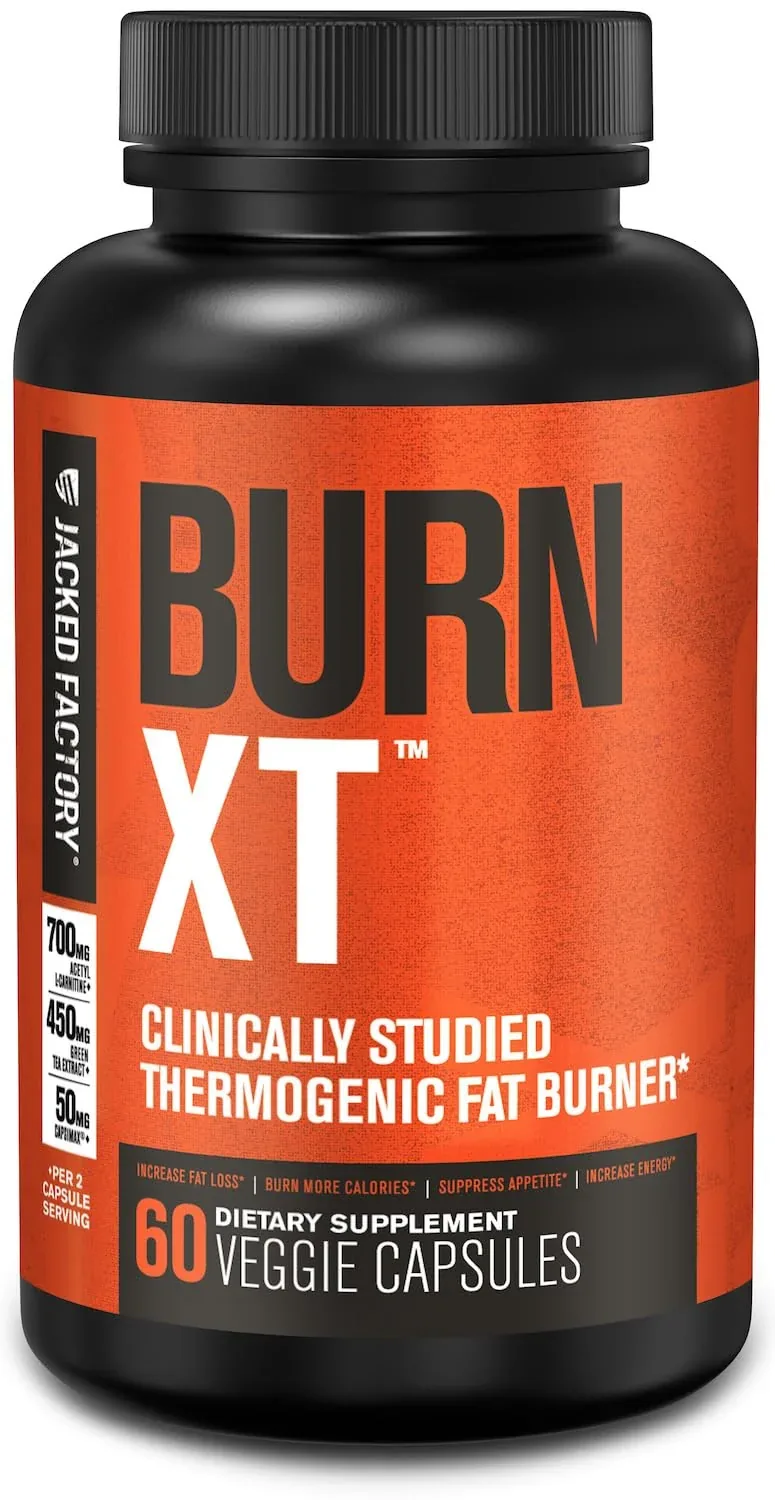
- A Burn XT serving supplies 700 mg of acetyl-L-carnitine HCl, or 350 mg in a single capsule.
- Most trials reporting a body-composition effect used 1,500 to 3,000 mg a day, so this is a quarter to a half of it.
- A meta-analysis of 37 randomised trials found small average reductions in weight and body-mass index, shrinking as trials got longer.
- The NIH fact sheet is direct that healthy people with normal carnitine status have little to gain from more of it.
- Carnitine's strongest evidence is not in body composition at all, and this article says where it is.
A note before you read on. Burn XT is a dietary supplement, not a treatment for anything. Nothing on this page is medical advice and none of it can know what else you take. Each two-capsule serving carries 270 mg of caffeine and 5 mg of piperine, and those two numbers are the ones to carry into a conversation with a pharmacist or a doctor before you start.
Acetyl L-carnitine is the largest single amount on this label, and it is the ingredient with the most published trial data behind it. It is also the one where this product's number sits furthest below what the research used. Both of those are true at once, and an honest article has to hold both.
What carnitine does inside a cell
Carnitine is not a vitamin and it is not an exotic import. Your body makes it from two amino acids, lysine and methionine, and you also eat it, mostly in red meat. A typical omnivorous diet supplies somewhere between 60 and 180 milligrams a day, and endogenous synthesis supplies more.
Its job is transport. Long-chain fatty acids cannot cross the inner mitochondrial membrane on their own, and carnitine is the shuttle that carries them across so they can be oxidised for fuel. That single sentence is the entire basis of carnitine's reputation in this category: if carnitine carries fat into the furnace, more carnitine should mean more fat burned.
The logic is clean and the biology is less obliging. In a healthy person the shuttle is not the bottleneck. Muscle carnitine content is tightly regulated, notoriously difficult to raise with oral supplementation, and already sufficient for the transport the cell is asking for. Adding more of a component that was never limiting does not usually speed a process up.
Why the acetylated form
This panel prints acetyl-L-carnitine HCl rather than plain L-carnitine, and the difference is worth thirty seconds.
The acetyl group makes the molecule cross the blood-brain barrier more readily. That is why acetyl L-carnitine turns up in cognition and nerve-health products as often as in gym products, and it is a real pharmacological difference rather than a marketing one.
For the purpose this label is selling, though, it is not obviously an advantage. The fatty-acid transport job happens in muscle mitochondria, not in the brain. If anything, the acetylated form is chosen here because it is the form with the broader reputation, and because it dissolves and absorbs well.
The HCl simply means the hydrochloride salt, which is what makes it stable enough to weigh into a capsule. It is not an active ingredient in its own right and it does not change the amount of carnitine you are getting in any way a buyer needs to adjust for.
What the trials used, and found
This is where a number beside a number is more useful than an adjective.
| Review | What it pooled | Typical daily amount | Finding |
|---|---|---|---|
| Talenezhad 2020 | 37 randomised controlled trials | 1,500–3,000 mg | Small average reductions in weight and BMI; effect shrank in longer trials |
| Pooyandjoo 2016 | Randomised controlled trials in adults | 1,800–3,000 mg typical | Statistically detectable weight reduction, clinically modest |
| NIH ODS fact sheet | Narrative review of the whole literature | Varies by indication | Little benefit expected in healthy people with normal carnitine status |
This product supplies 700 mg a serving, which is roughly a quarter to a half of the amounts in the first two rows.
The pattern in that table is worth naming because it recurs across supplement research generally. An effect that is real, small, and shrinks as trials get longer and better controlled is usually an effect near the edge of what a study can detect. That is not the same as nothing, and it is a long way from the impression the word thermogenic creates.
It is also worth noticing who was in those trials. A large share were people with obesity or a metabolic condition rather than healthy adults, and effects in that population do not transfer automatically to somebody who is broadly well and wants a quieter afternoon appetite.
Every amount printed, including the ones below the trials
Burn XT prints 700 mg of acetyl L-carnitine a serving, and this desk prints the trial range beside it. Sixty days to change your mind.
Price shown at checkout
Order Burn XTThe 700 mg question
So what does 700 milligrams do, if the trials used two to four times that?
The honest answer is that nobody knows precisely, because the dose-response relationship for carnitine on these endpoints is not well characterised. There are three defensible readings and they are not equally likely.
The pessimistic reading
If the effect at 2,000 milligrams is already small, the effect at 700 is smaller still, and quite possibly indistinguishable from nothing. This is the reading the NIH fact sheet's position most supports for a healthy person.
The optimistic reading
Some of the higher amounts in the literature were chosen for convenience or to guarantee an effect rather than because a lower amount had failed. A dose below a trial range is not automatically below a threshold, because the threshold was often never tested.
The reading this desk takes
That 700 milligrams is a real amount of a well-studied compound, that the trial result cannot be inherited at this amount, and that anyone buying this product should expect the caffeine and the catechins to do most of what they notice. That is why the ingredients page prints both numbers in a table rather than one of them in a sentence.
Where carnitine's evidence is strongest
Here is the part that rarely appears on a page selling a thermogenic: carnitine's best evidence is not in body composition at all.
The clearest uses are clinical. Primary carnitine deficiency, a genuine genetic disorder, responds to supplementation because the deficiency is the problem. Secondary deficiencies arising in dialysis patients and in some metabolic conditions are also treated with it. In both cases supplementation corrects a shortage rather than boosting a normal system.
Beyond that, the fact sheet from the NIH Office of Dietary Supplements is the place to read the full picture, indication by indication (NIH ODS on carnitine). It is thorough, it is free, and it is noticeably less enthusiastic than any supplement label.
The general lesson generalises well beyond carnitine. A nutrient that corrects a deficiency is doing something impressive. The same nutrient added to somebody who is not deficient is usually doing very little, and most of the supplement aisle is built on blurring the two situations.
Who actually has low carnitine
Four groups, and the third is the one that matters for readers of this page.
- People with primary carnitine deficiency. A rare inherited disorder, diagnosed and managed clinically.
- People on dialysis, or with certain metabolic disorders. Secondary deficiency, also managed clinically.
- Strict vegetarians and vegans. Dietary carnitine comes mostly from red meat, so intake is lower. Endogenous synthesis largely compensates, and blood levels are generally modestly lower rather than deficient.
- People taking certain medicines long-term, valproate among them, which can lower carnitine status.
If you are not in one of those four, you almost certainly have normal carnitine status, and the honest expectation from adding 700 milligrams a day is correspondingly modest. If you are a strict vegetarian, this is the one ingredient on the panel where you might reasonably expect a little more than the average buyer, and the evidence for that is suggestive rather than settled.
What to expect from this amount
| The claim you will read elsewhere | At 700 mg a day |
|---|---|
| It burns fat | It transports fatty acids, which was never the limiting step in a healthy person. Expect nothing you can feel |
| It improves exercise recovery | Some evidence exists, mostly at higher amounts and over weeks. Possible, small |
| It sharpens focus | The acetylated form crosses into the brain. Cognitive trials mostly used higher amounts and older populations |
| It works in the first week | No. Every endpoint where carnitine has shown anything was measured over weeks or months |
| It replaces a deficit | No ingredient does this, and the category's own outcome literature is clear about it |
The one expectation this table supports is patience, which is also what the 60-day money-back window is built around.
If you want the version of that table for the whole panel rather than this one ingredient, it is on the ingredients page as a dose-comparison table with all five rows.
Interactions worth knowing
Carnitine is generally well tolerated and the interaction list is short, which is not the same as empty.
- Thyroid hormone replacement. Carnitine has been reported to interfere with thyroid hormone action. Worth raising if you take levothyroxine.
- Valproate and some other seizure medicines. The relationship runs both ways and is worth a pharmacist's attention rather than a website's.
- Warfarin. Some reports of increased anticoagulant effect. Another pharmacist conversation.
- A fishy body odour. Not an interaction, and the one side effect people are surprised by. It is harmless, uncommon, dose-related, and it resolves on stopping.
As with everything else on this panel, the useful move is to take the numbers rather than the brand name to whoever dispenses your medicine (NCCIH, using dietary supplements wisely). For this ingredient that number is 700 milligrams of acetyl-L-carnitine HCl once a day.
And the broader point is worth repeating. This is the best-studied ingredient on the label, at the amount furthest below its research range. Knowing that is worth more than any adjective a bottle could print.
Sources
- Talenezhad 2020. Talenezhad N, Mohammadi M, Ramezani-Jolfaie N, et al. Effects of l-carnitine supplementation on weight loss and body composition: a systematic review and meta-analysis of 37 randomized controlled clinical trials with dose-response analysis. Clinical Nutrition ESPEN. 2020;37:9-23. PMID 32359762. https://pubmed.ncbi.nlm.nih.gov/32359762/
- Pooyandjoo 2016. Pooyandjoo M, Nouhi M, Shab-Bidar S, Djafarian K, Olyaeemanesh A. The effect of (L-)carnitine on weight loss in adults: a systematic review and meta-analysis of randomized controlled trials. Obesity Reviews. 2016;17(10):970-976. PMID 27335245. https://pubmed.ncbi.nlm.nih.gov/27335245/
- NIH ODS carnitine. National Institutes of Health, Office of Dietary Supplements. Carnitine: fact sheet for health professionals. https://ods.od.nih.gov/factsheets/Carnitine-HealthProfessional/
- NCCIH on using supplements. National Center for Complementary and Integrative Health. Using dietary supplements wisely. https://www.nccih.nih.gov/health/using-dietary-supplements-wisely
- NIH ODS weight-loss supplements. National Institutes of Health, Office of Dietary Supplements. Dietary supplements for weight loss: fact sheet for health professionals. https://ods.od.nih.gov/factsheets/WeightLoss-HealthProfessional/

Every page, every journal post, the bottle facts and the ingredients go through review by Dr. Pascale Carbonara, MD before they ship. We write from the printed Burn XT Supplement Facts panel and this desk’s own paperwork, confirm every PubMed identifier against the eutils summary API before publishing it, and print “not published” wherever a figure is not disclosed. This desk sells the product it writes about and says so on every page that touches money. Corrections go to [email protected] and move the review date forward. Last updated 17 September 2026.